YOUTH HOMELESSNESS

Seeking solutions with ‘radical imagination’
Associate professors M. Alex Wagaman, Ph.D., and Maurice Gattis, Ph.D., regularly work with youth and young adults experiencing homelessness, recognizing the value of their lived experiences and bringing their perspectives into projects as participants and co-leaders.
They recently completed a youth shared-housing project in Richmond focused on individuals ages 18-24 who identify as LGBTQIA+, pregnant and/or parenting. Virginia Housing Trust Fund grants totaling $2.25 million supported the four-year project.
“Maurice and I both felt called by the young people and our partners to radically imagine, what if we were to build something from the ground up in a way that we wanted it to run. … We were putting our radical imagination into practice as a form of change, to prove that things could be done radically differently,” Wagaman says.
That approach – collaboration and imagination – has infused other initiatives Wagaman has led the past year.
M. Alex Wagaman, Ph.D.
Dr. Wagaman is an associate professor in the VCU School of Social Work whose research focuses on participatory research and service approaches that promote engagement, leadership and resilience among youth and young adults who belong to populations that face marginalization and discrimination.

Maurice Gattis
Dr. Gattis is an associate professor in the VCU School of Social Work who has engaged in research activities regarding health disparities; lesbian, gay, bisexual, & transgender (LGBT) populations; homelessness; and adolescent risk behaviors in the United States, South Africa and Canada.

Seeing an ‘invisible population’
Under-18 youth experiencing homelessness who are also categorized as unaccompanied (not in the care of a parent or guardian) are at significant risk because they are ineligible for many government services and struggle in school compared to their housed peers.
Wagaman is leading a research study of high school-age students in Virginia who meet this dual criteria, working in collaboration with youth and researchers from five states and Project Hope-Virginia, which administers the federal McKinney-Vento Homeless Assistance Act. “This group of young people is a pretty invisible population,” Wagaman says.
The goals are to design a research study and gather data, then expand their team and scope for a national study, funded by a $75,000 vision grant from Chicago-based Spencer Foundation.

Going nationwide
Wagaman worked for a year as a special advisor with the U.S. Interagency Council on Homelessness, developing a youth homelessness plan and helping create the National Council on Youth Homelessness. NCYH, with more than a dozen young adults from across the country, serves as the central leadership for the National Youth Homelessness Partnership, an initiative funded by the Raikes Foundation and housed at VCU.
“Alex is the right person at this time for this work,” says Erika Jones-Haskins, USICH’s director of policy initiatives.
‘Steadfast advocate’
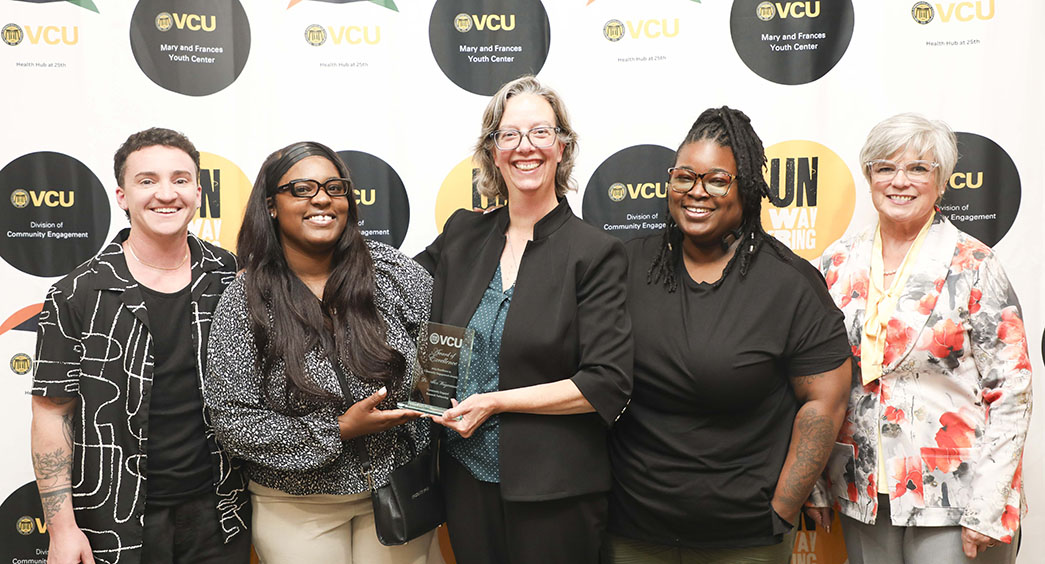
As if to validate Jones-Haskins’ comment, Wagaman was honored for her expansive work in spring 2025 with one of VCU’s inaugural Excellence in Community Engagement Awards, in the category Community-Engaged Research Partnership.
“I want to express my deep appreciation for those who have been in this work with me from the time I came to Richmond, and all those they represent. We do not do this work alone,” Wagaman says.
One longtime colleague praised her as someone who “creates safe spaces where people can learn and grow.”
A more recent colleague and collaborator, social work Ph.D. student Kade Goldin, says, “Alex intentionally partners with community organizations and individuals with lived expertise to enhance a particular knowledge base, build relationships and develop policy or practice recommendations.
"Alex establishes shared decision-making practices by cultivating connections and agreements with team members, making space for everyone’s input and waiting to move forward until all partners have weighed in.”